Table of Contents
ToggleShopping for kitchen cabinets at Lowe’s offers homeowners a middle-ground approach between big-box convenience and specialty showroom selection. With over 1,700 locations nationwide and a robust online ordering system, Lowe’s stocks everything from ready-to-assemble (RTA) budget cabinets to semi-custom hardwood builds. Whether you’re tackling a full kitchen remodel or replacing a few worn-out base cabinets, understanding the brand tiers, construction differences, and installation pathways available at Lowe’s can save both money and frustration down the road.
Key Takeaways
- Lowe’s kitchen cabinets offer a practical middle ground between budget-friendly ready-to-assemble options and premium semi-custom lines, with stock availability and fast shipping of one to two weeks compared to custom makers’ eight-to-twelve-week lead times.
- Choose budget RTA cabinets like Project Source or Diamond NOW for rental or temporary spaces ($100–$200 per linear foot), mid-range options like Kraftmaid for durability and customization ($250–$450 per linear foot), or premium Schuler cabinets for quality rivaling custom makers ($500–$700 per linear foot).
- Lowe’s kitchen cabinets come in five dominant styles—shaker, raised-panel, flat-panel, glass-front, and distressed finishes—with white shaker cabinets accounting for roughly 40% of sales due to their versatility across design aesthetics.
- Cabinet finish durability varies significantly: thermofoil resists moisture but may peel, while catalyzed conversion varnish on premium lines lasts 15–20 years, making the topcoat choice more important than the door style.
- DIY installation is feasible for experienced homeowners with a level and stud finder (expect 2–4 days for a 10×10 kitchen), or hire Lowe’s professional installers ($1,500–$3,500) to avoid costly measurement mistakes like forgetting filler strips or miscalculating clearance.
- Combine cabinet materials, hardware, crown molding, and accessories strategically; budget an additional 40–60% beyond cabinet cost for countertops, backsplash, and appliances, and watch for seasonal sales that offer 15–25% discounts on in-stock selections.
Why Choose Lowe’s for Your Kitchen Cabinets?
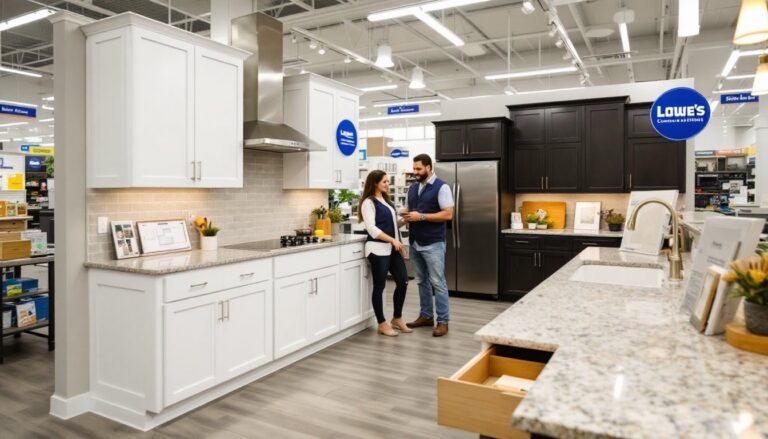
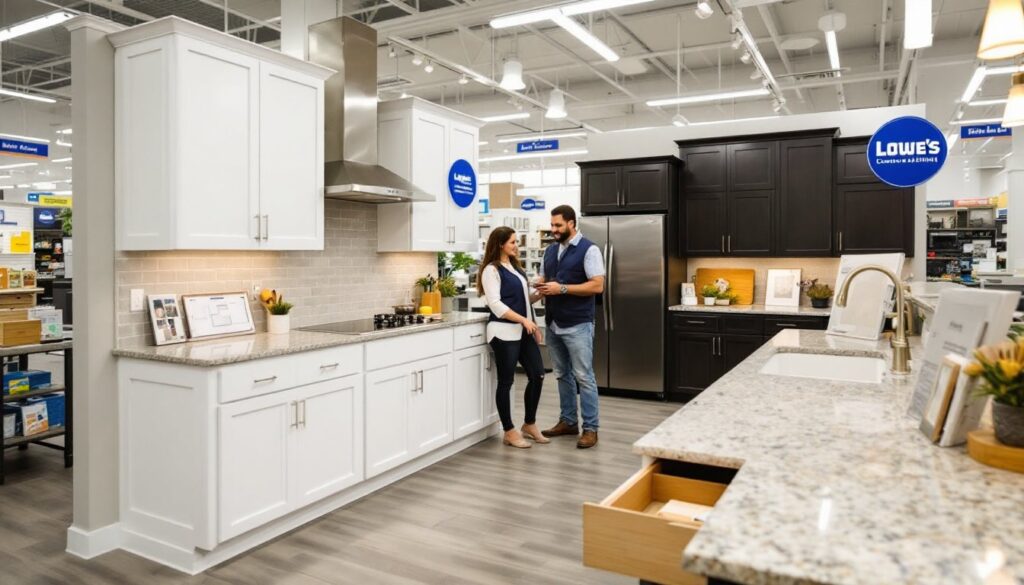
Lowe’s sits in a sweet spot for cabinet shoppers who want variety without paying showroom markup. The in-store selection typically includes display vignettes where homeowners can open drawers, test soft-close hinges, and compare finish quality side by side.
Stock availability is a major advantage. Many Lowe’s kitchen cabinets ship within one to two weeks, versus the eight-to-twelve-week lead times common with custom cabinet makers. For remodelers on tight timelines or those replacing a single damaged cabinet, this turnaround matters.
Lowe’s also bundles design services at many locations. A kitchen specialist will measure your space, generate a 3D layout, and provide an itemized quote at no charge, though you’re not obligated to buy. This helps DIYers catch issues like filler strip requirements or crown molding gaps before placing an order.
Finally, financing and return policies tend to be more flexible than specialty retailers. Lowe’s accepts major credit cards, offers project loans, and maintains a 90-day return window on unopened cabinets (always verify current policy before purchasing). That safety net is reassuring when ordering $5,000 to $15,000 worth of cabinetry.
Lowe’s Kitchen Cabinet Brands and Quality Levels
Lowe’s carries roughly a dozen cabinet lines, each targeting a different price tier and construction method. Understanding these distinctions prevents buyer’s remorse six months into a remodel.
Budget-Friendly Options
Project Source and Diamond NOW dominate the entry-level category. Both are ready-to-assemble (RTA) lines built with melamine-coated particleboard boxes and laminate or thermofoil doors. Expect cam-lock assembly, adjustable plastic clips for shelves, and overlay hinges.
These cabinets work well for rental properties, basement kitchenettes, or garage workshops where cosmetic perfection isn’t critical. A typical 10×10 kitchen (ten feet of base cabinets, ten feet of wall cabinets) runs $1,200 to $2,000 in materials. Construction quality is adequate if assembled carefully, but particleboard doesn’t forgive water exposure, keep them away from dishwashers and sinks without proper sealing.
Hampton Bay, another budget option, offers a step up with pre-assembled boxes in some SKUs. The trade-off is slightly higher cost but faster installation and fewer cam-lock failures.
Mid-Range and Premium Selections
Diamond (the parent brand, not Diamond NOW) and Kraftmaid represent Lowe’s mid-tier offerings. Both feature plywood box construction, dovetail or dowel drawer joints, and full-extension undermount drawer glides. Doors are solid wood or wood veneer over MDF cores. Remodel inspiration guides often highlight these brands for their balance of durability and finish variety.
Kraftmaid cabinets ship semi-custom, meaning you can specify dimensions in 3-inch increments and choose from dozens of door styles, stains, and glazes. Lead times stretch to four to six weeks, but the finished product rivals many independent cabinet shops. A 10×10 Kraftmaid kitchen typically costs $4,000 to $7,000.
Schuler sits at the premium end. Plywood construction throughout, soft-close hinges standard, and upgrade options like glass-front doors, pull-out spice racks, and integrated LED lighting. Expect $8,000 to $12,000 for a 10×10 layout. Schuler cabinets compete directly with custom cabinet makers on quality but arrive faster and integrate with Lowe’s installation services.
User reviews on forums discussing kitchen cabinets at Lowe’s consistently note that Kraftmaid and Schuler hold up better to daily wear than RTA options, particularly in high-moisture environments.
Popular Styles and Finishes Available at Lowe’s
Lowe’s kitchen cabinet selection mirrors current design trends without chasing every fleeting Instagram fad. Homeowners will find five dominant styles across most brands.
Shaker cabinets remain the workhorse. A recessed center panel framed by square rails and stiles fits both farmhouse and contemporary kitchens. Lowe’s stocks shaker doors in painted white, gray, navy, and natural wood tones (maple, oak, cherry). White shaker cabinets account for roughly 40% of Lowe’s kitchen sales, according to internal data shared in trade publications.
Raised-panel doors appeal to traditional and transitional remodels. These feature a center panel that protrudes above the frame, adding depth and shadow lines. Common finishes include cognac, espresso, and glazed antique white. The look pairs well with granite countertops and oil-rubbed bronze hardware.
Flat-panel (slab) doors serve modern and minimalist designs. No rails, no stiles, just a smooth surface in high-gloss acrylic, matte laminate, or wood veneer. Lowe’s mid-range brands offer slab doors in bold colors like charcoal, navy, or even two-tone combinations (white uppers, walnut lowers).
Glass-front cabinets are available as upgrade options in most lines. Use them sparingly, one or two wall cabinets flanking a range hood or above a prep sink. Seeded glass, frosted glass, and clear glass with mullion inserts all appear in the catalog.
Distressed and glazed finishes add character to painted cabinets. A glaze is a tinted topcoat that settles into door details, creating an aged or hand-rubbed look. This finish hides fingerprints and minor dings better than flat paint, making it practical for busy households.
Finish durability varies by brand. Thermofoil (a heat-bonded vinyl) resists moisture but can peel near dishwashers if the adhesive fails. Catalyzed conversion varnish (used on Kraftmaid and Schuler) is tougher but costs more. Always ask which topcoat a cabinet line uses, it’s the difference between a five-year lifespan and a twenty-year one.
How Much Do Lowe’s Kitchen Cabinets Cost?
Pricing for kitchen cabinets at Lowe’s depends on three variables: brand tier, kitchen size, and accessory count. The commonly cited “10×10 kitchen” is an industry benchmark but rarely matches real-world layouts.
Budget RTA cabinets (Project Source, Diamond NOW) run $100 to $200 per linear foot of cabinetry. A galley kitchen with 15 linear feet of base and wall cabinets costs $1,500 to $3,000 in materials. Add $300 to $600 for hardware (pulls, knobs), $150 to $300 for crown molding and toe kick, and $200 to $400 for drawer organizers or lazy Susans.
Mid-range semi-custom cabinets (Diamond, Kraftmaid) average $250 to $450 per linear foot. A standard L-shaped kitchen with 20 linear feet and a small island totals $5,000 to $9,000. Factor in $500 to $1,000 for upgraded drawer glides, pull-out trash bins, and soft-close door dampers.
Premium lines (Schuler) reach $500 to $700 per linear foot. A U-shaped kitchen with 25 linear feet, including a pantry cabinet and glass-front uppers, runs $12,500 to $17,500. At this tier, homeowners often add integrated lighting ($400 to $800), slide-out shelving ($200 to $400), and custom panel kits to match appliances ($300 to $600).
These figures exclude countertops, backsplash, sinks, faucets, and appliances. Budget an additional 40% to 60% of cabinet cost for those elements. Sales events (Memorial Day, Labor Day, Black Friday) can shave 15% to 25% off cabinet orders, but selection may be limited to in-stock SKUs.
Lowe’s offers a price-match guarantee if you find identical cabinets cheaper at a competitor within 30 days of purchase. It’s worth cross-shopping Home Depot and local cabinet outlets, especially during clearance cycles.
Installation Options: DIY vs. Professional Services
Installing kitchen cabinets demands accuracy, patience, and a willingness to work overhead. Lowe’s supports both DIY installers and those hiring pros through their installation network.
DIY installation is feasible for homeowners comfortable with a level, drill, stud finder, and shims. RTA cabinets from Project Source or Diamond NOW arrive flat-packed with cam-lock hardware and pictogram instructions. Assembly takes roughly 30 to 45 minutes per cabinet for a first-timer, less once you establish a rhythm. Wall cabinets must anchor into studs with 3-inch cabinet screws (not drywall anchors), a single wall cabinet can weigh 60 to 80 pounds when loaded with dishes.
Start by installing upper cabinets first while the floor is clear, using a ledger board (a straight 1×4 or 2×4 temporarily screwed to the wall at cabinet height) to support cabinets during leveling. Base cabinets follow, shimmed level and plumb before screwing together. Expect two to four full days for a 10×10 kitchen if working solo, or one to two days with a helper.
Safety gear: Safety glasses (drilling overhead sends debris into eyes), knee pads (for base cabinet work), and a dust mask (cutting particleboard or MDF generates fine particles). A corded drill or impact driver with a charged backup battery prevents mid-install delays.
Lowe’s installation service costs vary by region and project scope. As of 2026, typical quotes for a full kitchen cabinet install range from $1,500 to $3,500, including removal of old cabinets, installation of new boxes, and basic crown molding. This does not cover countertop removal, plumbing or electrical relocation, or structural modifications. Installers are independent contractors vetted by Lowe’s: service quality can vary, so check reviews for your local market before committing.
Permits are rarely required for cabinet replacement alone, but if the remodel involves moving a load-bearing wall, rerouting gas lines, or upgrading electrical panels, consult local building code. Many jurisdictions require licensed electricians for any work inside the panel, and plumbers for gas appliance hookups.
For organization and layout tips, many homeowners find that professional measurement services catch mistakes, like forgetting filler strips beside a refrigerator or miscalculating corner cabinet swing clearance, that DIYers often miss until boxes arrive.