Table of Contents
ToggleCat urine isn’t just unpleasant, it’s chemically designed to stick around. The uric acid crystals bond to fibers and substrates in ways that standard cleaners can’t touch, which is why that ammonia smell comes roaring back every time humidity rises or someone steps on the spot. If you’ve scrubbed a carpet with dish soap or doused it in vinegar only to have the odor return, you’ve learned the hard truth: conventional cleaners mask the problem. They don’t solve it. Enzymatic cleaners work differently. They break down the organic compounds in urine at a molecular level, eliminating both the stain and the odor permanently, if used correctly. This guide walks through exactly how these cleaners function, what to look for when choosing one, and how to apply them properly on different surfaces.
Key Takeaways
- Enzymatic cleaners permanently eliminate cat urine odor by breaking down uric acid crystals at the molecular level, unlike standard cleaners that only mask the smell temporarily.
- Choose an enzymatic cleaner with live bacterial cultures and a multi-enzyme formula (proteases, lipases, and amylases) to effectively digest all organic components of cat urine.
- Saturate the affected area completely and maintain 24–48 hours of damp dwell time for enzymatic cleaners to work properly; covering the area with plastic prevents premature evaporation.
- Use a UV blacklight to locate all hidden cat urine stains before treatment, and avoid pre-treating stains with ammonia, bleach, or other chemicals that deactivate enzymes.
- Enzymatic cleaners work on multiple surfaces including carpet, hardwood, tile, grout, and concrete, but application methods vary—carpet requires deep penetration while hardwood demands moisture control.
- Address the underlying cause of inappropriate urination by consulting a veterinarian, as medical issues or behavioral problems may continue triggering accidents even after thorough enzymatic cleaning.
Why Enzymatic Cleaners Are Essential for Cat Urine Removal
Cat urine contains three main components: urea, urochrome, and uric acid. The first two are water-soluble and wash away with basic cleaning. Uric acid is the troublemaker. It forms non-soluble crystals that bond to porous materials like carpet backing, wood subfloors, and grout. These crystals are invisible when dry but reactivate with moisture, releasing that signature ammonia stench.
Standard household cleaners, even heavy-duty ones, can’t break uric acid bonds. Soap-based products may lift surface stains, but they leave the crystals intact. Vinegar and baking soda neutralize some odor temporarily, but they don’t digest the organic matter. That’s where enzymatic cleaners earn their keep.
Enzymatic formulas contain specific bacteria cultures that produce enzymes (usually proteases, lipases, and amylases). These enzymes catalyze the breakdown of uric acid crystals, urea, and proteins into carbon dioxide and water, both of which evaporate. The bacteria consume the waste as a food source, multiplying until the organic material is gone, then dying off naturally. It’s a biological solution to a biological problem, and it’s the only method that addresses the root cause rather than masking symptoms.
How Enzymatic Cleaners Work on Cat Urine
Enzymatic cleaners rely on a two-stage process: enzymatic digestion and bacterial colonization. When the cleaner is applied, the liquid carrier spreads the enzyme solution into the contaminated area. The enzymes immediately begin breaking molecular bonds in the urine compounds, converting complex proteins and uric acid into simpler molecules.
At the same time, live bacterial cultures within the formula colonize the affected area. These bacteria feed on the broken-down organic matter, reproducing as long as a food source (urine residue) remains. As they consume the waste, they produce more enzymes, creating a self-sustaining cycle until the contamination is fully digested.
This process isn’t instant. Depending on saturation level, enzymatic cleaners need anywhere from 6 to 48 hours of dwell time to fully neutralize urine deposits. The area must stay damp during this period: if the cleaner dries too quickly, the bacteria die before finishing the job. That’s why many products recommend covering treated areas with plastic sheeting or damp towels.
Temperature and pH also matter. Most enzymatic bacteria thrive between 60°F and 80°F. Freezing or excessive heat can kill the cultures before they activate. Similarly, if you pre-treat a stain with ammonia-based or alkaline cleaners, you may raise the pH beyond the range where enzymes function effectively (typically pH 6–8). Always apply enzymatic cleaners to surfaces that haven’t been treated with incompatible chemicals.
Top Features to Look for in an Enzymatic Cleaner
Not all enzymatic cleaners are formulated equally. When comparing options, prioritize these features:
Live bacterial cultures. The label should explicitly state the product contains live enzymes and bacteria, not just enzyme byproducts. Some cheaper formulas use enzyme extracts without the living cultures, which limits effectiveness on deep or aged stains.
Multi-enzyme formula. Cat urine has multiple organic components, so the best enzymatic cleaner for cat urine will include proteases (for proteins), lipases (for fats), and amylases (for starches). A single-enzyme product may only partially digest the waste.
No harsh additives. Avoid cleaners with added fragrances, bleach, or ammonia. Ammonia smells like urine to cats and may encourage re-marking. Bleach can react with urine to produce toxic fumes and will kill the beneficial bacteria in the formula.
Pet-safe certification. Look for non-toxic, biodegradable formulas that won’t harm animals if they contact treated areas. Many manufacturers follow guidelines from Good Housekeeping when developing pet-safe formulations.
Adequate saturation capacity. For carpet or upholstery, you need enough liquid volume to penetrate as deeply as the urine soaked. If urine reached the carpet pad or subfloor, surface application won’t cut it. Some products offer concentrated formulas that you dilute yourself, allowing you to control saturation.
Transparent ingredient list. Quality products disclose their bacterial strains and enzyme types. If the label only says “proprietary blend,” you’re gambling on effectiveness.
Step-by-Step Guide to Using Enzymatic Cleaners Effectively
Proper application makes the difference between a permanent fix and a recurring problem. Follow this procedure for best results:
1. Blot Fresh Urine Immediately
If the accident is recent, use paper towels or a clean cloth to absorb as much liquid as possible. Press firmly but don’t rub, rubbing spreads urine deeper into fibers. Weigh down towels with a heavy object if needed.
2. Locate All Affected Areas
For dried or hidden stains, use a UV blacklight in a dark room. Cat urine fluoresces under UV, revealing spots you might miss otherwise. Mark each area with painter’s tape.
3. Remove Previous Cleaners
If you’ve already treated the stain with soap, vinegar, or commercial cleaners, rinse the area with plain water and blot thoroughly. Residual chemicals can deactivate enzymes.
4. Saturate the Stain Completely
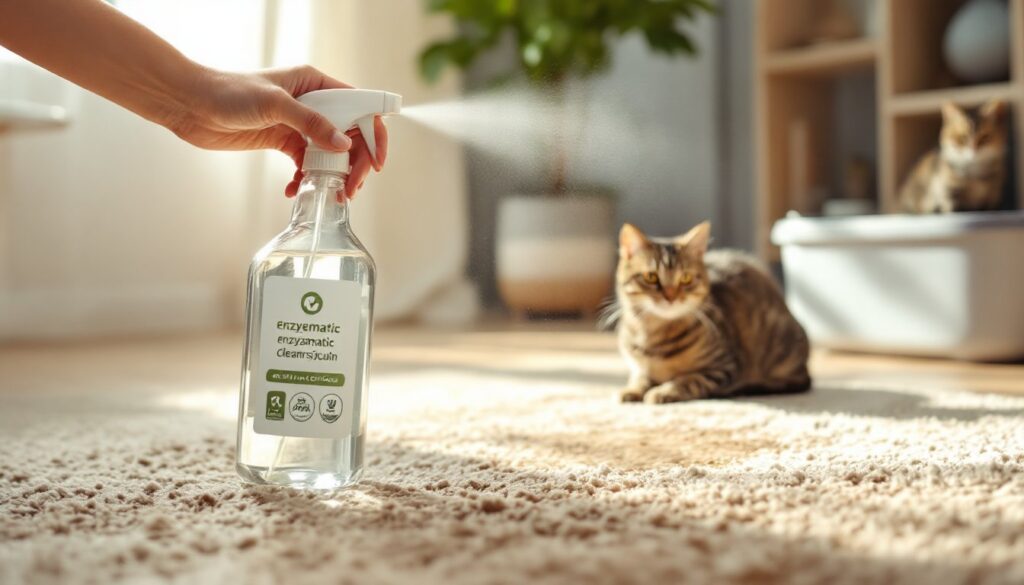
Apply enzymatic cleaner generously, use at least as much cleaner as the volume of urine deposited. For carpet, this often means soaking through to the pad. Pour the cleaner slowly, allowing it to wick into fibers rather than pooling on the surface. On hard floors, let the cleaner sit in a puddle over the stain.
5. Extend Dwell Time
Cover treated areas with plastic sheeting, aluminum foil, or a damp towel to slow evaporation. The cleaner must stay wet for 24–48 hours on deep or old stains. Check periodically and reapply if the area starts to dry.
6. Allow Complete Drying
Once the enzymatic process is complete, remove coverings and let the area air-dry naturally. Don’t use fans or heaters to speed drying during the active treatment phase, but you can after the dwell period ends. Ventilate the room to help dissipate moisture.
7. Evaluate and Retreat if Necessary
After drying, check the area with your nose and the blacklight. If odor or fluorescence persists, repeat the process. Heavily soiled areas or old stains may require two or three treatments.
Best Surfaces and Materials for Enzymatic Treatment
Enzymatic cleaners are versatile, but application methods vary by surface type.
Carpet and area rugs. This is where enzyme carpet cleaner for cat urine shines. The porous structure of carpet fibers and backing holds urine deeply, but it also allows enzymes to penetrate. For wall-to-wall carpet over padding, you may need to pull back the carpet to treat the pad and subfloor separately. If urine has soaked into the subfloor, apply cleaner directly to the wood and seal with a stain-blocking primer after enzymatic treatment is complete.
Hardwood and laminate. Use enzymatic cleaners cautiously on wood. Pool the cleaner over the stain without saturating the wood excessively, moisture can warp planks or delaminate engineered flooring. Wipe up excess after the dwell period and dry promptly. If urine has penetrated between planks, you may need to address the subfloor from below or replace affected boards.
Tile and grout. Glazed tile is non-porous, but grout is highly porous. Apply enzymatic cleaner liberally to grout lines and let it wick in. For stubborn odors, you may need to remove and replace grout, then reseal with an epoxy-based grout sealer to prevent future absorption.
Upholstery and mattresses. Blot thoroughly first, then apply cleaner with a spray bottle to avoid over-saturating cushion foam. Cover with plastic and allow extended dwell time. Some cushions have removable covers that can be machine-washed with an enzymatic laundry additive.
Concrete. Basements and garage floors are porous and hold odors tenaciously. Enzymatic cleaners work well here, but you’ll need high-volume application. After treatment, consider sealing the concrete with an epoxy or polyurethane coating to lock out future odors.
Drywall and baseboards. If urine has wicked into drywall, enzymatic treatment may help, but replacement is often necessary. Cut out affected sections and treat the studs and subfloor before installing new drywall.
Common Mistakes to Avoid When Treating Cat Urine
Even with the best enzymatic cleaner for cat pee, poor technique can sabotage results. Avoid these pitfalls:
Using steam cleaners before enzymatic treatment. Heat denatures enzymes and kills bacteria. If you steam-clean a urine stain, you’ll bake the uric acid into the fibers, making it even harder to remove. Always use enzymatic cleaners first: steam-clean only after the enzymes have done their work.
Mixing cleaners. Don’t combine enzymatic products with vinegar, bleach, hydrogen peroxide, or other household chemicals. Mixing can neutralize the enzymes or create harmful reactions. Stick to one product per treatment cycle.
Not using enough cleaner. Skimping on volume is the number-one reason treatments fail. You need to saturate the contaminated area completely. If urine soaked through carpet padding to the subfloor, surface spraying won’t reach it.
Rushing the process. Enzymatic action takes time. Cutting the dwell period short leaves uric acid crystals intact, and the odor will return. Be patient and keep the area damp as long as the product label recommends.
Skipping the blacklight check. What you can’t see can still smell. A blacklight reveals the true extent of contamination and helps you avoid under-treating the area.
Ignoring the litter box. If your cat is urinating outside the box, the real problem may be medical (urinary tract infection, kidney disease) or behavioral (stress, dirty litter, box location). Cleaning up accidents is necessary, but addressing the root cause prevents repeat incidents. Consult a vet if accidents become frequent.
Reintroducing the cat too soon. Cats have a powerful sense of smell. Even if you can’t detect urine anymore, lingering scent markers may prompt your cat to re-mark the spot. Keep the area off-limits until it’s completely dry and odor-free, confirmed by both your nose and a blacklight. Some homeowners find that applying a natural deterrent spray after enzymatic treatment discourages repeat marking.
Conclusion
Enzymatic cleaners eliminate cat urine odor permanently by digesting the organic compounds standard cleaners leave behind. Success depends on choosing a multi-enzyme formula with live bacteria, saturating the contaminated area fully, and allowing adequate dwell time. Skipping steps or rushing the process leaves uric acid crystals intact, guaranteeing the smell returns. Treat the problem thoroughly the first time, and you won’t need to treat it again.